
Sedalia City Directory Shelf and Access
Sedalia Public Library is the starting point for historical city directories. Its genealogy collection says directories reach back to 1867 and places them beside cemetery records, marriage and census material, family histories, school yearbooks, obituaries, newspapers, and local history. The individual editions do not form one uninterrupted digital run. Some years are reported in local or regional holdings, and the library should confirm a particular volume before a trip or request. That distinction matters when a family appears in one edition but not the next.
| Collection | Years | Where Held | Access |
|---|---|---|---|
| C. Henry DeVoe city directory | 1873-74 | Reported local and state historical holdings | Earliest known run, verify the shelf before relying on access |
| Early Sedalia directory material | 1876 copy; 1883 local run | State Historical Library, State Historical Society, and local collection leads | Confirm the exact holding institution and edition |
| Reported Sedalia city directories | 1884-85 through selected 1950 and later holdings | Sedalia Public Library, with regional holdings as a cross-check | In-person collection and staff-assisted research; year availability varies |
| Sedalia Democrat microfilm | From December 1871 | Sedalia Public Library | Microfilm for notices, addresses, events, and obituary context |
| Sedalia Times | 1894-1905 | Library of Congress | Digitized page images, PDF, and OCR for a separate local newspaper |
A reported sequence includes editions from 1884-85, 1886-87, 1888-89, 1889-90, 1891-92, 1895, and selected later runs. A regional holdings list also identifies microfilm for several twentieth-century years, but it does not prove Sedalia Public Library has every one. Note: Treat a missing volume as a custody question first, not proof that a household left Sedalia.
Sedalia City Directory Research at the Library
The Sedalia Public Library genealogy collection offers more than printed directories. It identifies an in-building Library Edition genealogy database, Missouri Digital Heritage, newspaper resources, FamilySearch links, and a Memory Lab alongside the local history materials. A focused request gives staff a full name, date range, place, and a narrow record question. The library asks for at least 48 hours for research requests, depending on the size of the task. Ask whether the target year is alphabetic, reverse, criss-cross, telephone, or business-only before assuming that an address will be indexed.
The library's genealogy page is also the source for the local-history service pictured here.
Use the collection page as the handoff to staff and in-library tools, then retain the citation details from the volume or reel actually consulted.
Missouri Digital Heritage is useful for learning what city directories can contain, including alphabetical people and places, addresses, occupations, forwarding information, businesses, and occasional biographies. The inspected Missouri Digital Heritage directory collection did not yield a Sedalia digitized run. That is why the practical fallback is the local library, its microfilm, and a research request rather than a promise of a fully searchable Sedalia database.
Sedalia City Directory Years in Context
The library’s 1867 starting point is a collection statement, while the earliest known directory identified in the Sedalia residential historic-resources report is C. Henry DeVoe’s 1873-74 edition. The same report documents an 1876 copy and an 1883 local run. Those early references are especially useful when a name is tied to rail-era growth, a downtown business, or an address that has since changed form. Do not infer the original publisher or an abbreviation system from a later book. The publisher’s own front matter controls.
- 1867: Sedalia Public Library says its city-directory collection reaches this far back.
- 1873-74: C. Henry DeVoe’s directory is the earliest known Sedalia directory reported in the local historic-resources study.
- 1876 and 1883: An 1876 copy and an 1883 local run are documented historical leads.
- 1884-85 onward: Reported local years continue through selected twentieth-century editions and later holdings, with gaps requiring shelf verification.
The 1883 Library of Congress Sedalia Sanborn map item can help place a lot, building use, or nearby landmark after a directory yields an old street reference. It is a map cross-check, not a replacement for the printed entry. Note: Keep an address, the directory year, and the map year separate because they may not describe the same moment.
Reading a Sedalia City Directory Entry
A city directory entry is evidence of a printed moment. No live Sedalia page was captured in the research, so exact local abbreviations and reverse-book coverage must be checked in the actual volume. Missouri Digital Heritage describes the kinds of information directories may supply, while the Sedalia collection is the place to confirm what a particular publisher used. Photograph or transcribe the page header and abbreviation key before interpreting a short mark beside a name.
| Printed name | Record spelling, initials, and any cross-reference exactly as printed. |
|---|---|
| Household clue | A spouse or other household notation may appear, but its format depends on the edition. |
| Occupation or business | May identify work, a business connection, or a business-directory entry. |
| Street address | Use it as the edition’s location clue, then compare with maps and other dated records. |
| Publisher and page | These citation details make a later check of initials, abbreviations, and wording possible. |
- Criss-cross directory
- A directory arranged by street address rather than by surname. Sedalia reverse or criss-cross availability needs year-specific confirmation from the library.
- Householder index
- An index organized around a household or address. It may not identify every person at that location.
- Abbreviation key
- The publisher’s explanation of shortened terms and symbols, usually found in the volume itself. Do not carry a key from one year into another.
Owner, renter, widow, boarding, and similar notations are examples of fields that can occur in historical directories, but they should never be claimed for a Sedalia edition until the year’s key is checked. The same caution applies to a reverse section. Note: A readable abbreviation is still only as reliable as the publisher’s key for that volume.
Sedalia Newspapers Beside City Directories
Directory entries and newspapers answer different questions. The Sedalia Democrat microfilm begins in December 1871 at the library and can add notices, civic roles, addresses, marriages, deaths, advertisements, and event dates around a directory listing. The digitized Sedalia Times covers 1894-1905 and is an African-American newspaper. It should be searched alongside the Democrat, not treated as a duplicate of it. OCR is a discovery aid; verify a name against the page image.
Newspapers may explain a name that vanishes between editions, but a notice does not automatically establish a later home address. Search initials, surname variants, spouse clues, and the address line from the directory. Yearbooks, cemetery records, family histories, and obituary resources at the library provide other local layers when the newspaper trail is thin.
Tracing a Sedalia City Directory Household
Start with the earliest confirmed appearance and work forward and backward through the nearest available editions. Copy the printed name, household clue, address, occupation or business detail, publisher, and page. Then test variant spellings and initials. A person’s disappearance can mean a move, death, unlisted status, or a changed spelling, so it needs a second source before it becomes a conclusion. The federal population census is released on a 72-year schedule, making it a useful household check between directory years when the relevant census has become public.
- Find the surname or address in a confirmed Sedalia city directory edition and save the citation.
- Check the nearest earlier and later editions for the same name, initials, spouse clue, business, or street.
- Ask the library whether a reverse or criss-cross section exists for those exact years, then compare the address sequence.
- Pair the dated directory sequence with an available federal census, preserving the census year rather than assuming annual continuity.
- Use a newspaper, cemetery record, obituary index, marriage record, or deed index to explain a move, death, or ownership change.
For modern parcel and street evidence, use the separate Sedalia street directory workflow after the historical address has been normalized. That current-record path has a different purpose from the historical shelf.
Sedalia Directory History and Courthouse Custody
Sedalia’s directory research benefits from a records-custody timeline. Pettis County moved its county seat to Sedalia in 1865. The courthouse in use from 1884 burned on June 22, 1920, and the present courthouse was built and dedicated in 1925. These events do not prove that a particular directory was lost, but they do explain why a historical trail may shift between library shelves, local offices, and archival microfilm. When a related deed, probate, or county record is missing locally, consult the Missouri State Archives Pettis microfilm guide for the record series and reel coverage.
After an older directory points to a household, preserve its original spelling, date, page, and address before changing repositories. A nineteenth-century question may require a directory, newspaper image, and archives reel; a current address question may start in the parcel system instead. That handoff protects the difference between a historical listing and a present-day record.
Sedalia City Directory Archive Handoff
When the library does not hold the needed year, the next step is to identify the repository before assuming the volume is unavailable. The State Historical Society of Missouri research service is a documented statewide starting point for historical collections, while the research did not verify a definitive Pettis County Historical Society holdings catalog. Describe that local society as an archive lead, not as a confirmed source for a specific directory year. State Archives resources can also supply county record-series context when a directory clue points toward a deed, court, tax, or probate search.
The State Historical Society research page shown below is a starting point for that repository handoff.
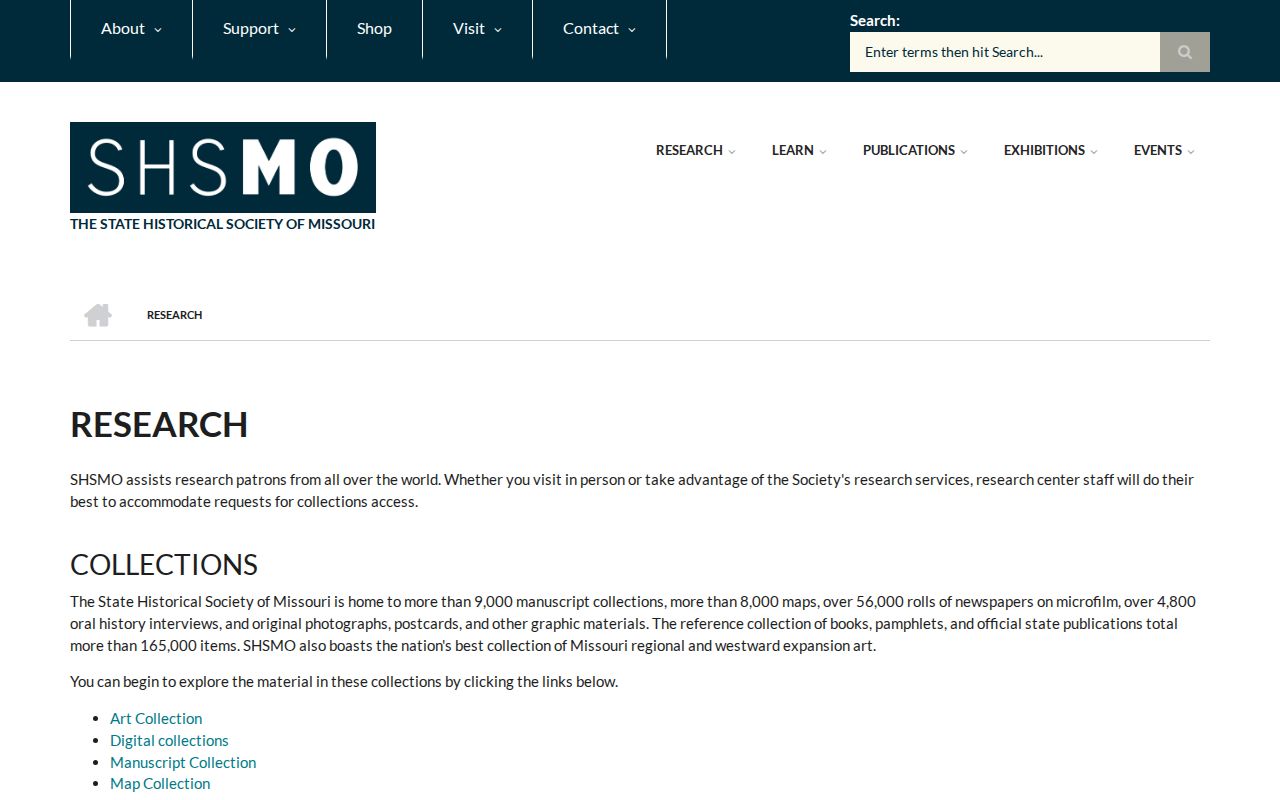
Bring the directory citation, year, surname variants, and place name to an archive inquiry so staff can identify a catalog or collection path without guessing at a volume.